






You do not need an expensive gym membership or complicated workout equipment to build stronger legs and glutes. With a little consistency, the right exercises and a balanced routine, you can improve your lower-body strength right from your home.
A good leg and glute workout at home can help you develop stronger muscles, improve balance and make everyday activities like climbing stairs, walking and carrying groceries feel easier.
Whether you are a beginner or someone who already exercises regularly, lower-body training is worth including in your fitness routine. The key is to start with exercises you can perform comfortably and gradually increase the challenge as your strength improves.
In this guide, we will explore some effective exercises, a simple weekly workout plan and practical tips to help you build stronger legs and glutes without making fitness complicated.
Why Should Women Train Their Legs and Glutes?
Legs and glutes are among the largest muscle groups in the body. They play an important role in everyday movement, stability and physical strength.
Regular lower-body training offers several benefits.
- Improves muscle strength: Exercises such as squats and lunges help strengthen the muscles in your thighs, hips and glutes.
- Supports better balance: Stronger lower-body muscles help you maintain stability during everyday movements.
- Makes daily activities easier: Building leg strength can make walking, climbing stairs and standing for longer periods more comfortable.
- Supports joint function: Strong muscles around the hips, knees and ankles help support movement and stability.
- Improves overall fitness: Lower-body exercises can be part of a balanced full-body fitness routine.
You do not need to focus on appearance alone. Building strength is also about feeling capable, active and confident in your body.
8 Effective Exercises to Build Stronger Legs and Glutes at Home
These exercises use your body weight, so you can begin without purchasing special equipment. A stable chair, exercise mat or resistance band can be useful for certain variations.
1. Bodyweight Squats
<text color=”secondary” size=”xs” weight=”medium”>TARGET MUSCLES: THIGHS AND GLUTES</text>
Squats are one of the most useful exercises for lower-body strength. They work several muscle groups, including your quadriceps, glutes and supporting muscles around your hips.
How to perform:
- Stand with your feet approximately shoulder-width apart.
- Keep your chest lifted and your back in a comfortable neutral position.
- Bend your knees and push your hips backwards as if sitting on a chair.
- Lower yourself as far as you can while maintaining control.
- Push through your feet to return to the starting position.
Beginner recommendation: 2 sets of 10–12 repetitions.
Avoid letting your knees collapse inward. If regular squats feel difficult, practise sitting down and standing up from a stable chair.
2. Glute Bridges
<text color=”secondary” size=”xs” weight=”medium”>TARGET MUSCLES: GLUTES AND HAMSTRINGS</text>
Glute bridges are a beginner-friendly exercise that focuses on the muscles around your hips and the back of your thighs.
How to perform:
- Lie on your back with your knees bent.
- Keep your feet flat on the floor, approximately hip-width apart.
- Place your arms beside your body.
- Tighten your abdominal muscles and squeeze your glutes.
- Lift your hips until your body forms a comfortable straight line from your shoulders towards your knees.
- Lower your hips slowly without dropping them suddenly.
Beginner recommendation: 2 sets of 12–15 repetitions.
Focus on squeezing your glutes rather than pushing your lower back into an exaggerated arch.
3. Reverse Lunges
<text color=”secondary” size=”xs” weight=”medium”>TARGET MUSCLES: THIGHS AND GLUTES</text>
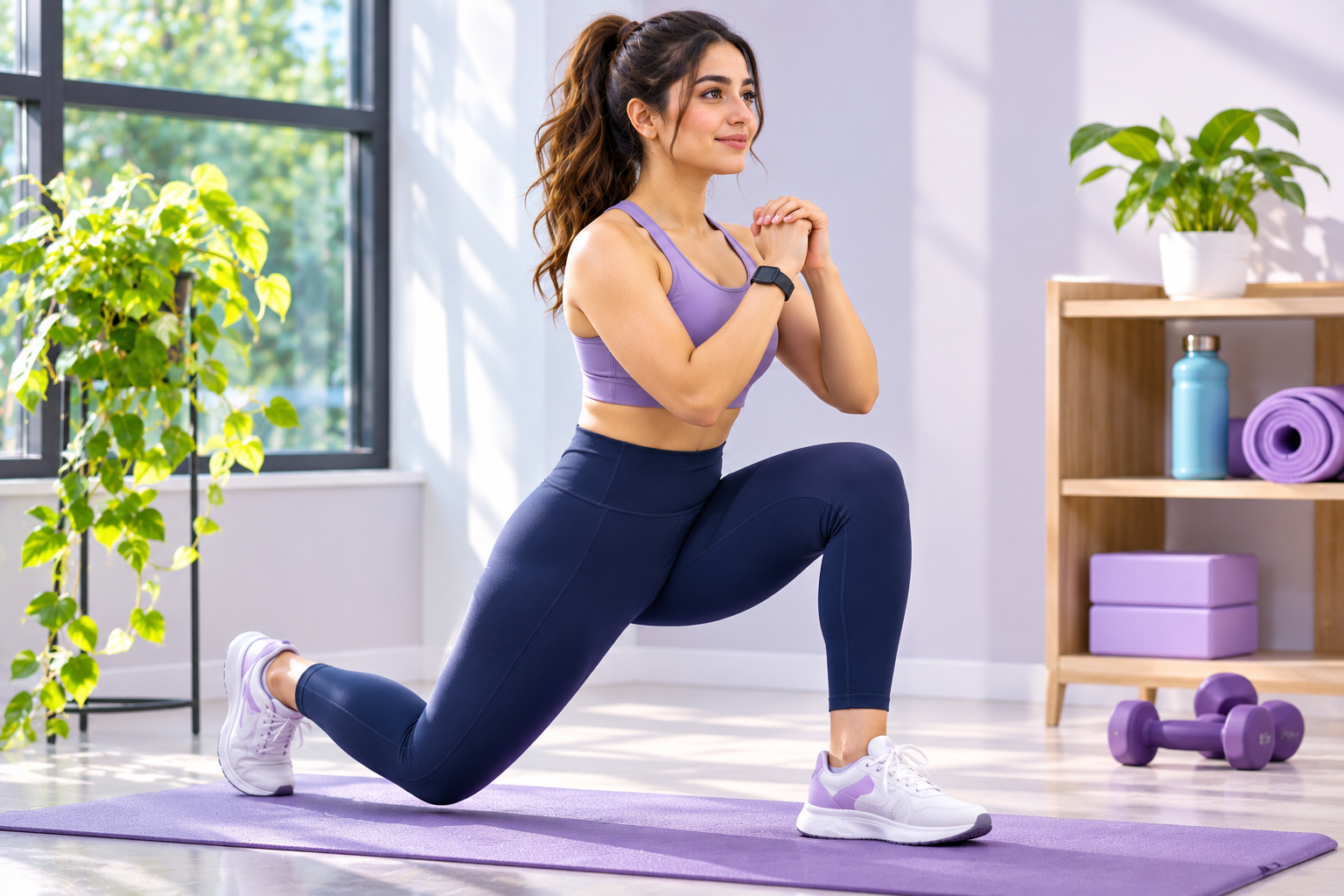
Reverse lunges help strengthen each leg individually. They also challenge your balance and coordination.
How to perform:
- Stand upright with your feet hip-width apart.
- Step one foot backwards.
- Bend both knees comfortably while keeping your upper body upright.
- Push through your front foot to return to the starting position.
- Repeat with the opposite leg.
Beginner recommendation: 2 sets of 8–10 repetitions per leg.
If balancing is difficult, hold the back of a stable chair or stand near a wall for support.
4. Donkey Kicks
<text color=”secondary” size=”xs” weight=”medium”>TARGET MUSCLES: GLUTES</text>
Donkey kicks are a simple floor exercise that targets the glute muscles.
How to perform:
- Start on your hands and knees.
- Keep your hands underneath your shoulders and knees underneath your hips.
- Tighten your abdominal muscles.
- Lift one bent leg backwards and upwards without twisting your hips.
- Slowly return your knee towards the floor.
- Repeat on the other side.
Beginner recommendation: 2 sets of 10–12 repetitions per leg.
Avoid arching your back or swinging your leg to create momentum. Controlled movement is more important than lifting your leg very high.
5. Step-Ups
<text color=”secondary” size=”xs” weight=”medium”>TARGET MUSCLES: THIGHS AND GLUTES</text>
Step-ups are a functional exercise that helps strengthen your legs while improving coordination.
How to perform:
- Stand in front of a low, stable step or platform.
- Place one foot firmly on the step.
- Push through that foot to bring your body upwards.
- Bring the other foot onto the platform.
- Step down carefully and repeat.
Beginner recommendation: 2 sets of 8–10 repetitions per leg.
Use a platform that does not wobble or slide. Avoid using chairs or unstable household furniture.
6. Side-Lying Leg Raises
<text color=”secondary” size=”xs” weight=”medium”>TARGET MUSCLES: OUTER HIPS AND GLUTES</text>
This exercise works the muscles along the outer hips, which contribute to hip stability and movement.
How to perform:
- Lie on your side with your legs extended.
- Support your head with your lower arm.
- Keep your hips stacked and your upper body relaxed.
- Slowly lift your top leg without rotating your body.
- Lower it with control.
- Repeat on the other side.
Beginner recommendation: 2 sets of 12 repetitions per side.
Keep the movement slow and avoid swinging your leg.
7. Wall Sit
<text color=”secondary” size=”xs” weight=”medium”>TARGET MUSCLES: THIGHS AND LOWER-BODY MUSCLES</text>
Wall sits are an isometric exercise, meaning you hold a position rather than repeatedly moving through repetitions.
How to perform:
- Stand with your back against a wall.
- Walk your feet slightly forward.
- Slowly slide down the wall into a comfortable seated position.
- Keep your feet flat on the floor.
- Hold the position while breathing normally.
- Push through your feet to stand up.
Beginner recommendation: 2 holds of 15–20 seconds.
You do not need to lower yourself until your thighs are parallel to the floor. Choose a comfortable position and gradually increase the holding time.
8. Standing Calf Raises
<text color=”secondary” size=”xs” weight=”medium”>TARGET MUSCLES: CALVES</text>
Strong calves support walking, running, climbing stairs and everyday movement.
How to perform:
- Stand upright with your feet hip-width apart.
- Hold a stable surface for balance if needed.
- Slowly lift your heels off the floor.
- Pause briefly at the top.
- Lower your heels slowly.
Beginner recommendation: 2 sets of 12–15 repetitions.
Avoid bouncing. Keep the movement controlled throughout.
Simple Weekly Leg and Glute Workout Plan for Beginners
If you are new to lower-body training, start with two workout days per week and allow recovery time between sessions.
Here is a simple routine you can follow.
| Exercise | Sets | Repetitions |
|---|---|---|
| Bodyweight squats | 2 | 10–12 |
| Glute bridges | 2 | 12–15 |
| Reverse lunges | 2 | 8 per leg |
| Donkey kicks | 2 | 10 per leg |
| Side-lying leg raises | 2 | 12 per side |
| Calf raises | 2 | 12–15 |
Rest for approximately 45–90 seconds between sets, or longer if you need it. Adjust the repetitions to your current fitness level.
Suggested weekly schedule:
- Monday – Lower-body workout
- Tuesday – Walking or light activity
- Wednesday – Rest or gentle stretching
- Thursday – Lower-body workout
- Friday – Walking or another activity you enjoy
- Saturday – Light full-body movement
- Sunday – Rest and recovery
This is a starting point, not a strict requirement. You can adjust the schedule according to your energy, fitness level and other activities.
You can read: How to Combine Walking and Strength Training for Better Fitness
How to Make Your Legs and Glutes Stronger Over Time
Doing the same number of repetitions forever may eventually become less challenging. As your strength improves, you can gradually increase the difficulty of your workouts.
This is called progressive overload.
Here are some simple ways to apply it:
Increase Your Repetitions Gradually
If 10 squats feel comfortable, try 12 or 15 during your next workout, provided you can maintain good form.
Add Another Set
You can gradually move from two sets to three sets when your body is comfortable with the current routine.
Try Resistance Bands
Resistance bands can add extra challenge to exercises such as glute bridges and side steps.
Use Light Dumbbells
Once bodyweight exercises become manageable, you can introduce light dumbbells for squats, lunges and other movements.
Focus on Better Technique
Increasing the number of repetitions is not the only way to improve. Better control, stability and movement quality are also signs of progress.
You do not need to increase everything at once. Make small changes and allow your body time to adapt.
Foods That Support Muscle Strength and Recovery
Exercise is only one part of building stronger muscles. Your body also needs enough food, protein, fluids and rest to recover from training.
Include a variety of nutritious foods in your everyday meals.
Protein-rich foods:
- Eggs
- Milk and yoghurt
- Paneer
- Lentils and beans
- Tofu
- Fish and lean meats
Carbohydrate sources:
- Oats
- Rice
- Whole-wheat roti
- Potatoes
- Fruits
- Whole grains
Healthy fat sources:
- Nuts and seeds
- Olive oil
- Avocado
- Nut butters
You do not need expensive supplements to begin a fitness routine. A balanced diet with sufficient protein and overall energy is a useful foundation.
Also, drink water throughout the day and get enough sleep to support recovery.
Common Workout Mistakes to Avoid
If you want to make steady progress, pay attention to how you perform each exercise.
1. Skipping Warm-Ups
Starting intense exercises without preparing your body can make movement feel uncomfortable.
Spend around 5–10 minutes walking in place, performing gentle leg swings and moving your hips and ankles before your workout.
2. Increasing Workout Intensity Too Quickly
Trying to perform too many repetitions or adding heavy weights too soon can increase the risk of injury.
Progress gradually and choose exercises that match your current strength.
3. Ignoring Rest Days
Muscles need time to recover after challenging workouts. Training the same muscle groups intensely every day is unnecessary for most beginners.
Allow recovery between demanding lower-body sessions.
4. Using Incorrect Form
Rushing through squats or lunges can affect your balance and technique.
Perform each movement slowly, use a comfortable range of motion and stop if you experience sharp or unusual pain.
5. Expecting Overnight Results
Building strength takes time. Your progress depends on consistency, recovery, nutrition, training intensity and individual factors.
Focus on improving your performance rather than expecting immediate physical changes.
Final Thoughts
Building stronger legs and glutes at home does not have to involve complicated workout routines or expensive equipment.
Exercises such as squats, glute bridges, reverse lunges, donkey kicks and step-ups provide a useful starting point for women who want to improve their lower-body strength.
Begin with manageable repetitions, focus on proper technique and gradually make your workouts more challenging as you become stronger.
Most importantly, remember that fitness is not a race. Some days you may feel energetic, while other days you may need more rest. Both are normal parts of building a sustainable routine.
Stay consistent, give your body time to recover and celebrate the small improvements along the way. Stronger muscles are built through regular effort, patience and healthy habits.
Frequently Asked Questions
1. Can I build stronger legs and glutes at home without equipment?
Yes. Bodyweight exercises such as squats, lunges, glute bridges and step-ups can help improve lower-body strength. You can introduce resistance bands or weights later as your fitness improves.
2. How many days a week should women train their legs and glutes?
Beginners can start with two lower-body strength sessions per week, with recovery time between workouts. The ideal frequency depends on your fitness level, exercise intensity and recovery.
3. How long does it take to build stronger legs and glutes?
Progress varies from person to person. You may notice improvements in exercise control and strength over several weeks of consistent training. Visible muscle changes can take longer and depend on nutrition, training and individual factors.
4. Which exercise is best for strengthening glutes at home?
Glute bridges, squats, reverse lunges and donkey kicks are useful exercises. Combining different movements helps train the glutes and surrounding muscles from different angles.
5. Can walking help strengthen legs and glutes?
Walking supports lower-body activity and general cardiovascular fitness. Walking uphill or using stairs can increase the challenge. However, strength exercises are also useful for building muscle strength.
6. Should I do leg workouts every day?
Most beginners do not need intense leg workouts every day. Allow your muscles time to recover between challenging sessions. You can stay active through gentle walking or other comfortable activities on recovery days.
7. Do I need protein supplements to build stronger muscles?
No. Many women can get enough protein through everyday foods such as eggs, dairy products, lentils, beans, tofu and other protein-rich options. Supplements are not essential for everyone.