







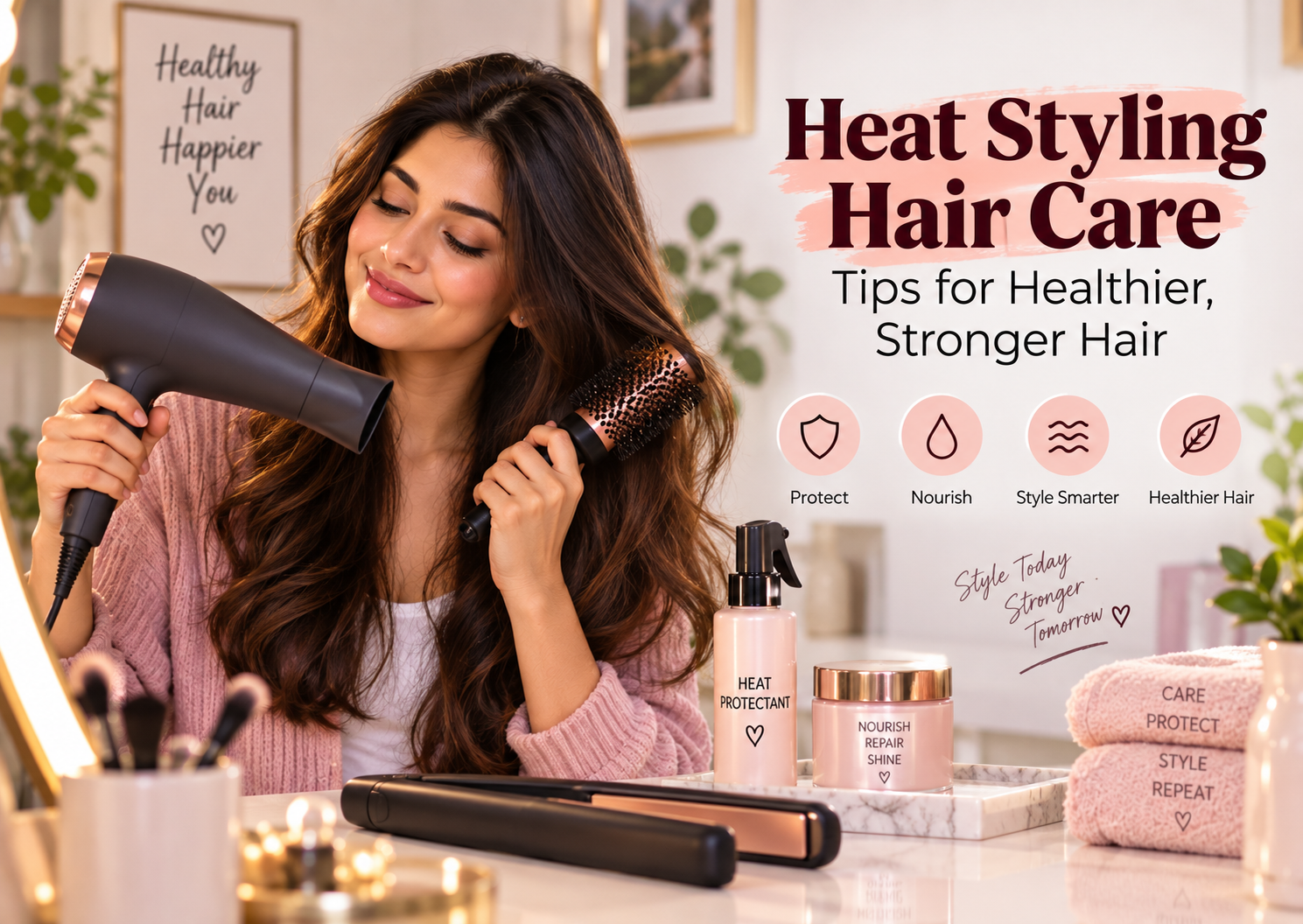
Heat styling hair can help you create sleek straight hair, soft waves, bouncy curls, and polished hairstyles in minutes. But frequent exposure to high temperatures can leave hair dry, brittle, frizzy, and more prone to breakage.
That doesn’t mean you have to give up your favorite styling tools.
The key is learning how to use them more carefully and giving your hair enough protection and recovery between styling sessions.
Whether you regularly use a straightener, curling iron, hot brush, or blow dryer, a few simple changes can help you maintain healthier-looking hair while still enjoying different hairstyles.
Why Heat Styling Can Damage Your Hair
Hair is made primarily of a protein called keratin. High temperatures can affect the structure of the hair shaft and contribute to dryness and damage, particularly with repeated or excessive exposure.
Signs that your hair may be experiencing too much heat include:
- Dry or rough texture
- Increased frizz
- Split ends
- Hair breakage
- Lack of shine
- Brittle ends
- Difficulty maintaining moisture
Damage can build gradually, so your hair may look fine initially and become noticeably weaker after repeated styling.
Always Use a Heat Protectant
One of the simplest ways to improve your heat styling routine is to use a heat protectant before applying hot tools.
Heat protectants are designed to create a protective layer around the hair and can help reduce the impact of heat.
Apply the product according to its instructions and make sure it is distributed evenly through the areas you plan to style.
Don’t assume that your regular conditioner or hair oil automatically provides adequate heat protection.
Look specifically for a product designed for thermal protection.
Don’t Use the Highest Temperature
More heat doesn’t necessarily mean better styling.
Using extremely high temperatures can increase the risk of damage, especially when you repeatedly pass the tool over the same section.
Start with a lower or moderate temperature and increase it only if necessary.
Your ideal setting can depend on factors such as:
- Hair thickness
- Hair texture
- Whether your hair is chemically treated
- The styling tool
- The hairstyle you’re creating
Fine or fragile hair generally needs more caution with heat than thick, coarse hair.
Never Straighten Soaking-Wet Hair
Using a traditional flat iron on wet or very damp hair can cause serious damage.
Make sure your hair is properly dry before using a straightener or curling iron unless the tool is specifically designed for wet-to-dry styling and its instructions allow it.
If you’re blow-drying your hair, remove excess water gently with a towel or microfiber towel first.
This reduces the amount of time your hair needs to be exposed to the dryer.
Let Your Hair Dry Naturally When Possible
You don’t have to completely avoid your blow dryer.
But if you have time, allowing your hair to partially air-dry before blow-drying can reduce the amount of time it spends under direct heat.
For example, gently towel-dry your hair and allow it to air-dry until it is partially dry before finishing your hairstyle with a dryer.
Avoid aggressively rubbing wet hair with a towel, as wet hair is more vulnerable to mechanical damage.
Keep the Blow Dryer Moving
Holding a blow dryer in one place for too long concentrates heat on the same section.
Keep the dryer moving rather than directing intense heat at one spot continuously.
A nozzle attachment can also help direct airflow more precisely.
When possible, use a moderate heat setting rather than the hottest option.
Don’t Hold Hot Tools on Your Hair Too Long
Curling irons and wands should not remain pressed against the same section of hair for an unnecessarily long time.
Wrap the hair around the tool according to the manufacturer’s instructions, then release it.
If your hair isn’t holding the style, increasing the heat dramatically isn’t always the best solution.
You may need to adjust the section size, technique, or product instead.
Avoid Repeated Passes With a Straightener
Running a flat iron over the same section again and again increases heat exposure.
Prepare your hair properly first.
Make sure it is dry, detangled, and protected.
Then use controlled passes rather than repeatedly going over the same area.
If a section doesn’t straighten immediately, check your technique and temperature rather than automatically increasing the heat.
Section Your Hair Before Styling
Working with smaller, manageable sections can make heat styling more efficient.
Instead of repeatedly passing a tool through large sections, divide your hair into sections and style each one carefully.
This can help you achieve your desired result with fewer passes.
It also makes it easier to apply your heat protectant evenly.
Give Your Hair Breaks From Heat
Even if you use heat protectant, your hair can benefit from occasional breaks.
Try having several no-heat days throughout the week.
You could experiment with:
- Natural waves
- Braids
- Loose buns
- Ponytails
- Heatless curls
- Air-dried styles
Your hair doesn’t need to look professionally styled every day.
Sometimes a simple natural hairstyle is the healthiest option.
Try Heatless Hairstyles
If you love curls and waves but don’t want to use a curling iron every day, experiment with heatless methods.
Depending on your hair type, you can try:
- Loose overnight braids
- Heatless curling ribbons
- Twists
- Soft rollers
- Loose buns
Be gentle when removing them.
Pulling tightly or brushing aggressively can cause another type of damage even when you haven’t used heat.
Don’t Forget Your Hair Ends
The ends of your hair are usually the oldest and most fragile part.
They often show dryness and split ends first.
When applying conditioner or a suitable hair treatment, pay particular attention to your lengths and ends.
Avoid repeatedly applying high heat to the very tips of your hair.
If your ends are severely split, trimming them may be more helpful than trying to repair the split itself.
Use Conditioner Regularly
Heat styling can contribute to dryness, so conditioning is an important part of a healthy hair routine.
Apply conditioner mainly to the lengths and ends, following the instructions on the product.
If your hair is particularly dry, you may also benefit from an occasional deep-conditioning treatment.
Choose products based on your hair’s needs rather than buying the most expensive option.
Don’t Overwash Your Hair
How often you should wash your hair depends on your scalp, hair type, lifestyle, and styling habits.
Washing too frequently with harsh products can leave some hair types feeling dry.
On the other hand, avoiding washing for too long can allow excess oil, sweat, styling products, and buildup to accumulate on the scalp.
Find a washing schedule that keeps your scalp comfortable and your hair manageable.
Be Gentle When Your Hair Is Wet
Wet hair can be more vulnerable to stretching and breakage.
After washing:
- Don’t aggressively rub your hair with a towel.
- Gently squeeze out excess water.
- Use a wide-tooth comb if appropriate for your hair type.
- Start detangling from the ends.
- Work upward gradually.
- Avoid pulling through stubborn knots.
Small changes in how you handle wet hair can reduce unnecessary breakage.
Don’t Use Too Many Styling Products
Using multiple products doesn’t necessarily make a hairstyle better.
Too much mousse, spray, gel, serum, oil, and cream can leave your hair heavy or create buildup.
Start with the smallest amount that gives you the desired result.
If you use several styling products regularly, make sure you’re also cleansing your hair appropriately.
Be Careful With Hair Oils Before Heat
Hair oils can make hair feel softer and shinier, but you shouldn’t assume every oil is a substitute for a heat protectant.
Some oils may not be designed to protect hair from high-temperature styling tools.
Use a product specifically formulated for heat protection when you’re going to use a straightener, curling iron, or other hot tool.
If you want to use oil for shine or conditioning, follow the product’s directions and consider applying it after styling if appropriate.
Don’t Heat Style Damaged Hair Every Day
If your hair is already showing significant signs of damage, consider reducing heat styling temporarily.
Look for signs such as:
- Excessive breakage
- Very dry ends
- Severe frizz
- Increased split ends
- Hair that feels unusually rough
- Loss of elasticity
Give your hair time away from intense styling and focus on gentle care.
Protect Your Hair From More Than Heat
Heat isn’t the only thing that can affect your hair.
Hair can also be exposed to:
- Sun
- Chlorinated water
- Salt water
- Chemical treatments
- Tight hairstyles
- Frequent brushing
- Mechanical friction
If you regularly color, bleach, relax, or chemically treat your hair, you may need to be particularly careful with additional heat exposure.
Don’t Pull Your Hair Too Tightly
You can avoid heat damage and still experience breakage from tight hairstyles.
Repeatedly wearing very tight ponytails, buns, or braids can put stress on the hair and scalp.
Choose looser styles when possible and vary where you place your ponytail or bun.
Sleep With Your Hair Gently Protected
Your hair can experience friction while you sleep.
If you find that your hair becomes tangled or frizzy overnight, consider:
- Using a satin or silk pillowcase
- Wearing a loose braid
- Using a soft scrunchie
- Keeping long hair loosely tied
Avoid sleeping with hair pulled tightly.
Trim Split Ends When Necessary
Once a hair strand has split, skincare-style products can’t permanently fuse the split back together.
Regular trims can help keep the ends looking neater and prevent existing splits from travelling farther up the strand.
How frequently you need a trim depends on your hair, styling habits, and personal goals.
Pay Attention to Your Scalp
Healthy-looking hair starts with a healthy scalp environment.
Keep your scalp clean according to your needs and avoid applying heavy styling products directly to the scalp unless they’re designed for that purpose.
If you experience persistent itching, flaking, sores, unusual hair loss, or scalp irritation, consider speaking with a dermatologist or other qualified healthcare professional.
A Simple Heat Styling Routine
If you regularly use hot tools, keep your routine simple.
Before Styling
Wash and condition → Gently dry → Detangle → Apply heat protectant → Section hair
During Styling
Use a suitable temperature → Keep the tool moving → Avoid repeated passes → Don’t hold heat on one section too long
After Styling
Allow hair to cool → Avoid excessive brushing → Use a small amount of suitable finishing product if needed
This simple process can help reduce unnecessary heat exposure.
How Often Should You Use Heat Styling?
There isn’t one perfect number of days for everyone.
Your ideal frequency depends on your hair’s condition, texture, chemical treatments, and the amount of heat you’re using.
If you use high heat every day, consider reducing the frequency.
Try alternating between:
Heat-styled days
and
No-heat days
The goal is to reduce cumulative damage while still enjoying the hairstyles you like.
Common Heat Styling Mistakes to Avoid
Using Extremely High Heat
Higher temperatures can increase damage without necessarily producing a better result.
Skipping Heat Protectant
Don’t treat thermal protection as an optional step when using hot tools regularly.
Styling Wet Hair With a Traditional Flat Iron
Always ensure your hair is dry unless the specific tool is designed for wet-to-dry use.
Repeatedly Passing Over the Same Section
One controlled pass can be better than several unnecessary ones.
Using Heat Every Day
Give your hair regular breaks.
Holding a Blow Dryer Too Close
Keep the dryer moving and use an appropriate distance and temperature.
Ignoring Damaged Ends
If your ends are repeatedly splitting and breaking, reducing heat and getting a trim may help.
How to Keep Your Hair Looking Good Without Heat
You don’t need a hot tool every time you want your hair to look polished.
Try:
- A sleek low ponytail
- A loose braid
- A claw-clip hairstyle
- A neat bun
- Heatless waves
- A half-up hairstyle
- A natural textured look
Sometimes changing your styling technique is enough to give your hair a break.
When to Get Professional Help
If you’re experiencing significant or persistent hair loss, scalp problems, severe breakage, or sudden changes in your hair, don’t assume heat styling is the only cause.
Many factors can affect hair health, including nutritional issues, hormones, medications, stress, genetics, and medical conditions.
A dermatologist can help identify the underlying cause and recommend appropriate treatment.
Frequently Asked Questions
Does heat styling permanently damage hair?
Repeated or excessive heat exposure can damage the hair shaft. How much damage occurs depends on factors such as temperature, frequency, duration, and the condition of your hair.
Does heat protectant completely prevent hair damage?
No. Heat protectants can help reduce the impact of heat, but they don’t make hair immune to damage. Using appropriate temperatures and limiting heat exposure are still important.
How often can I straighten my hair?
There isn’t a universal safe frequency. If your hair is becoming dry, brittle, or prone to breakage, reduce how often you straighten it and lower the amount of heat exposure.
Is blow-drying better than straightening?
They expose hair to heat differently, so neither should automatically be considered harmless. A blow dryer used with moderate heat and kept moving may be less intense than repeatedly pressing a very hot flat iron against the same section, but technique matters.
Can I use hair oil as a heat protectant?
Don’t assume a regular hair oil provides adequate thermal protection. Use a product specifically labeled and formulated for heat protection when using hot styling tools.
How can I repair heat-damaged hair?
You can’t completely reverse structural damage to an individual hair strand, but you can reduce further damage with gentler styling, conditioning, appropriate products, fewer hot-tool sessions, and trims when needed.
Final Thoughts
You don’t have to give up your straightener, curling iron, or blow dryer to have healthier-looking hair.
The key is smarter heat styling.
Use a proper heat protectant, avoid unnecessarily high temperatures, make sure your hair is dry before using traditional hot tools, limit repeated passes, and give your hair regular breaks.
Also remember that healthy hair isn’t about making it look perfect every day.
Sometimes the best thing you can do is let your natural texture show, give your hair some time away from heat, and focus on gentle care.
Style your hair when you want to—but don’t let your styling routine become a daily battle between looking good and keeping your hair healthy. With a little care and consistency, you can enjoy both. ✨
This article is for general beauty and hair-care information. If you experience significant hair loss, scalp irritation, or persistent breakage, consider consulting a qualified healthcare professional or dermatologist.