







Have you ever worn an outfit that looked amazing on someone else but somehow didn’t look quite the same on you?
The problem may not be the outfit itself. It could simply be the color.
Choosing the right colors for your skin tone can make your overall appearance look more balanced, fresh, and polished. The right shade can complement your natural coloring, while the wrong one may make your complexion appear dull or washed out.
But choosing colors doesn’t have to be complicated. You don’t need to follow strict fashion rules or completely replace your wardrobe.
The first step is understanding your skin undertone.
Skin Tone vs Skin Undertone: What’s the Difference?
Before choosing clothing colors, it’s useful to understand the difference between skin tone and undertone.
Your skin tone is the surface color of your skin. It can range from very fair to deep and can change somewhat with sun exposure.
Your undertone is the subtle color underneath your skin. It generally falls into three categories:
- Warm
- Cool
- Neutral
Your skin tone can change over time, but your undertone tends to remain relatively consistent.
That’s why understanding your undertone can be more useful when choosing colors.
How to Find Your Skin Undertone
You don’t need professional color analysis to get a general idea of your undertone.
Look at Your Veins
Look at the veins on the inside of your wrist in natural daylight.
If they appear more:
Greenish → you may have a warm undertone.
Blue or purple → you may have a cool undertone.
A mixture of both → you may have a neutral undertone.
This isn’t a perfect scientific test, but it can be a helpful starting point.
Think About How Gold and Silver Look
Another simple method is to compare gold and silver jewelry.
If gold tends to complement your complexion more naturally, you may have a warm undertone.
If silver looks particularly flattering, you may have a cool undertone.
If both look good, you may have a neutral undertone.
Again, these are styling guidelines rather than strict rules.
Consider Your Natural Skin Reaction to the Sun
Some people notice that their skin tends to tan more easily, while others tend to burn more quickly.
This can sometimes provide another clue about undertones, although sun reaction isn’t a reliable standalone method for determining undertone.
Natural daylight is generally the best environment for judging colors.
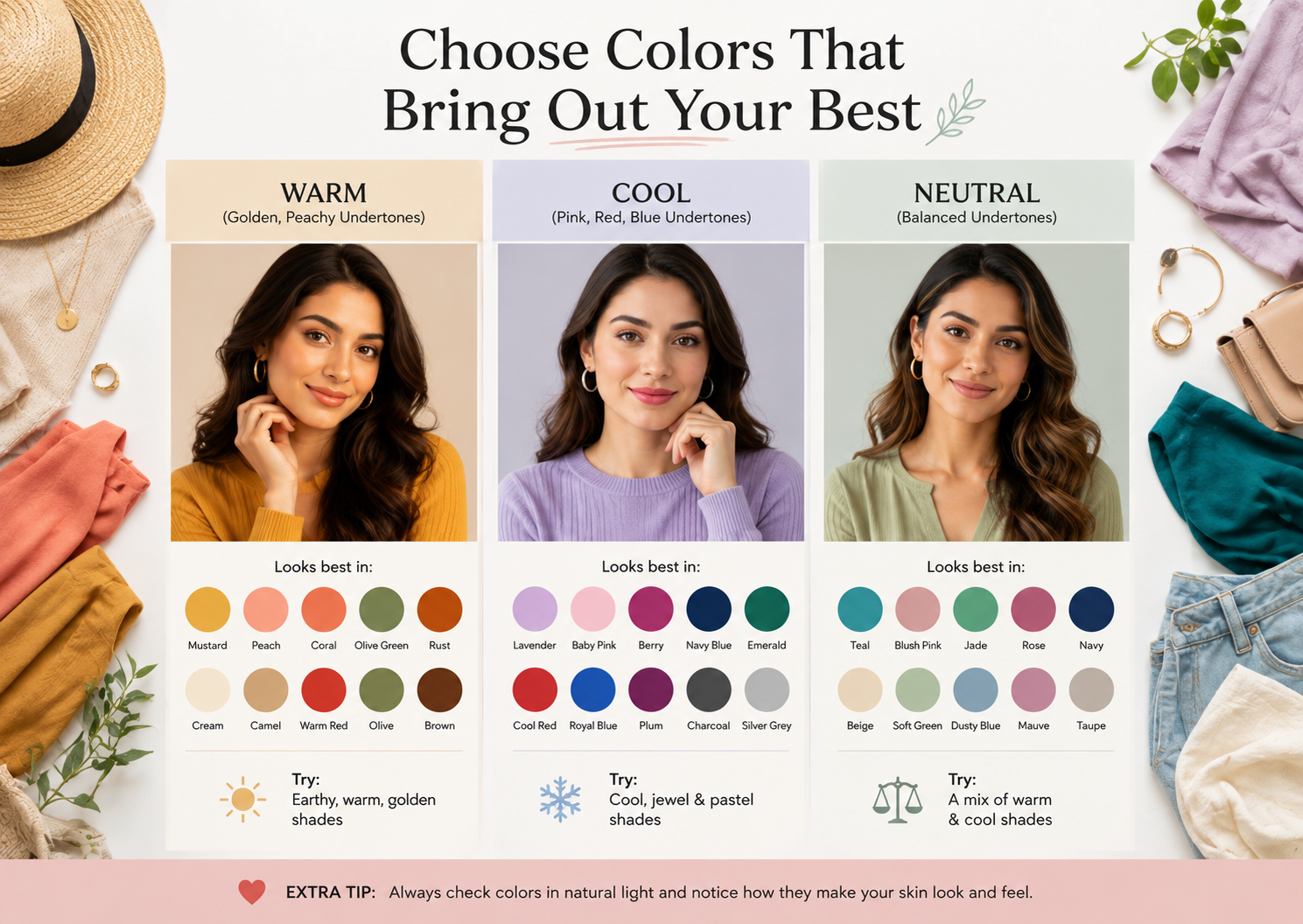
Best Colors for Warm Skin Undertones
Warm undertones often have golden, peachy, yellow, or slightly olive-looking qualities.
If you have a warm undertone, earthy and warm shades can be particularly flattering.
Try colors such as:
- Terracotta
- Coral
- Peach
- Warm beige
- Camel
- Mustard
- Olive green
- Rust
- Chocolate brown
- Cream
- Warm red
These shades can create a harmonious appearance because they share similar warmth with your complexion.
Warm Colors Don’t Mean You Have to Avoid Cool Colors
Fashion rules aren’t absolute.
If you love a cool-toned blue or pink, you can absolutely wear it.
You can also balance a color by combining it with another shade that complements your complexion.
For example, try a cooler blue top with warm-toned accessories.
The goal is to use color theory as a guide—not a restriction.
Best Colors for Cool Skin Undertones
Cool undertones often have pink, reddish, or bluish qualities.
Colors with cooler or jewel-like characteristics can work beautifully.
Consider:
- Navy
- Cobalt blue
- Emerald
- Lavender
- Cool pink
- Berry
- Burgundy
- Plum
- Blue-red
- Crisp white
- Charcoal
These shades can provide contrast without overpowering your natural coloring.
Best Colors for Neutral Undertones
If you have a neutral undertone, you may find that both warm and cool shades work well.
This can make experimenting with colors much easier.
Try:
- Soft pink
- Teal
- Jade
- Rose
- Beige
- Navy
- Cream
- Dusty blue
- Soft green
- Burgundy
Neutral undertones often give you more flexibility, so don’t be afraid to experiment.
What About Different Skin Tones?
It’s important not to confuse skin tone with undertone.
A person with fair skin can have a warm, cool, or neutral undertone.
The same is true for medium, tan, olive, and deep skin tones.
Instead of assuming that one skin tone automatically suits one color palette, consider both:
Your surface skin tone + your undertone.
This creates a more personalized approach to choosing colors.
Colors That Can Make Your Skin Look Dull
There isn’t one universal list of “bad colors.”
A shade that looks dull on one person may look incredible on another.
However, if you notice that a particular color consistently makes your complexion appear:
- Grey
- Extremely pale
- Yellowish
- Tired
- Washed out
it may not be the most flattering shade near your face.
Try moving that color away from your face.
For example, instead of wearing it as a top, use it as a skirt, trousers, shoes, handbag, or accessory.
You don’t have to completely remove your favorite color from your wardrobe.
How to Choose Colors for Everyday Outfits
If you’re unsure where to begin, build your wardrobe around a few versatile shades.
Start With Neutrals
Good wardrobe neutrals can include:
- Black
- White
- Cream
- Navy
- Beige
- Grey
- Brown
Then add colors that complement your undertone.
For example, someone who loves earthy warm colors might build around cream, brown, olive, rust, and terracotta.
Someone who prefers cooler colors might choose navy, grey, lavender, burgundy, and emerald.
Use the 60-30-10 Color Rule
A simple styling trick is to think about proportions.
60% — dominant color
30% — secondary color
10% — accent color
For example:
A cream outfit could be paired with a brown jacket and a small burgundy accessory.
You don’t have to follow these percentages exactly. It’s simply a useful way to avoid making an outfit look visually overwhelming.
Don’t Forget Your Hair Color
Your clothing colors interact with more than your skin.
Hair color can also influence how certain shades look around your face.
For example, a dramatic contrast between dark hair and a bright outfit can create a completely different effect from the same outfit on someone with lighter hair.
Instead of following a rigid chart, stand in natural light and try different colors near your face.
Your own reflection is often more useful than a generic color guide.
Match Your Colors to the Occasion
The best color isn’t always just about your skin tone.
The occasion matters too.
For Work
Try sophisticated shades such as:
- Navy
- Burgundy
- Cream
- Charcoal
- Olive
- Soft blue
For Casual Wear
Experiment with:
- Pastels
- Denim blue
- Earth tones
- Soft greens
- Warm neutrals
For Parties
You can experiment with:
- Jewel tones
- Metallic accents
- Rich burgundy
- Emerald
- Cobalt
- Deep purple
If you’re interested in building better everyday outfits, you can also check out our guide on [The Best Fashion Styling Tricks for Every Body Shape].
How to Choose the Right Color for a Dress
When you’re buying a special dress, don’t rely only on the color name.
Two shades of “pink” can look completely different.
For example:
- Dusty rose
- Hot pink
- Peach pink
- Berry pink
all create different effects.
If possible, hold the fabric close to your face in natural light.
Ask yourself:
Does this shade make my complexion look brighter or duller?
That’s often more useful than simply asking whether you like the color.
Use Accessories to Experiment With Color
If you’re nervous about wearing a bold shade, start small.
Try colorful:
- Earrings
- Scarves
- Handbags
- Shoes
- Belts
- Hair accessories
This allows you to experiment without completely changing your wardrobe.
You may discover that a color you wouldn’t normally wear works beautifully as an accent.
Don’t Forget Makeup When Choosing Clothing Colors
Clothing and makeup can work together.
For example, if you’re wearing a warm-toned outfit, warm blush or lip shades may create a coordinated appearance.
Cool-toned clothing can pair nicely with cooler makeup shades.
However, you don’t need to match everything perfectly.
Sometimes contrast creates the most interesting look.
For more simple beauty inspiration, you can also read [Simple Beauty Tips That Make You Look Fresh and Well Put Together].
Black and White: Do They Suit Everyone?
Black and white are classic wardrobe colors, but the specific shade can make a difference.
Some people look particularly striking in pure white.
Others may prefer softer ivory, cream, or off-white.
Similarly, black can be incredibly flattering, but charcoal or deep navy may create a softer effect for some people.
If pure white feels too harsh near your face, try cream.
If black feels too intense, experiment with charcoal or navy.
Don’t Be Afraid of Bright Colors
Bright colors can feel intimidating.
You might think:
“I could never wear that.”
But the right styling can make bold shades surprisingly easy to wear.
If a bright color feels too strong near your face, balance it with a neutral.
For example:
Cobalt blue + white
Hot pink + black
Orange + cream
Emerald + beige
Bright yellow + navy
The contrast can make the outfit look intentional rather than overwhelming.
Seasonal Colors Can Make Styling Easier
Your wardrobe can naturally change with the seasons.
Spring
Try:
- Peach
- Soft green
- Lavender
- Light blue
- Cream
Summer
Try:
- White
- Coral
- Turquoise
- Bright pink
- Sky blue
Autumn
Try:
- Rust
- Olive
- Mustard
- Burgundy
- Brown
Winter
Try:
- Navy
- Emerald
- Plum
- Burgundy
- Charcoal
These aren’t strict rules. Wear whatever makes you feel confident.
The Most Important Rule: Wear What Makes You Feel Good
Color theory is helpful, but confidence matters too.
If your favorite color doesn’t appear on a traditional “best colors for your undertone” chart, that doesn’t mean you can’t wear it.
Fashion should help you express yourself.
If you love a particular color, find a way to incorporate it.
Try changing the shade, pairing it with a flattering neutral, or using it as an accessory.
There is no single color palette that every person must follow.
Quick Color Guide
| Undertone | Colors to Try |
|---|---|
| Warm | Coral, peach, olive, mustard, rust, camel, cream |
| Cool | Navy, lavender, emerald, berry, plum, cool pink |
| Neutral | Teal, rose, jade, beige, navy, cream, soft green |
Use this as a starting point rather than a strict rulebook.
Frequently Asked Questions
How do I know which colors suit my skin tone?
Start by identifying your undertone as warm, cool, or neutral. Then experiment with colors that complement that undertone and see how they look in natural light.
What colors look best on warm skin tones?
Warm undertones often pair well with earthy and warm shades such as coral, peach, terracotta, olive, mustard, rust, camel, and cream.
What colors look best on cool skin tones?
Cool undertones can work particularly well with shades such as navy, cobalt, emerald, lavender, berry, plum, cool pink, and crisp white.
What colors suit neutral undertones?
Neutral undertones are generally versatile and can work well with both warm and cool shades, including teal, rose, navy, cream, beige, jade, and soft green.
Can I wear colors that don’t match my undertone?
Absolutely. Undertone guides are simply styling tools. If you love a color, wear it. You can also use it as an accessory or combine it with a more flattering shade.
Is skin tone the same as skin undertone?
No. Skin tone describes the surface color of your skin, while undertone refers to the subtle underlying hue. People with the same skin tone can have different undertones.
Final Thoughts
Learning how to choose the right colors for your skin tone can make getting dressed much easier, but you don’t need to follow fashion rules too strictly.
Start by understanding your undertone, experiment with different shades, and pay attention to how colors make your complexion look in natural light.
Most importantly, remember that the best color is often the one that makes you feel confident.
Fashion isn’t about limiting yourself to a specific palette.
It’s about discovering which colors help you feel like your best self—and then wearing them with confidence.