






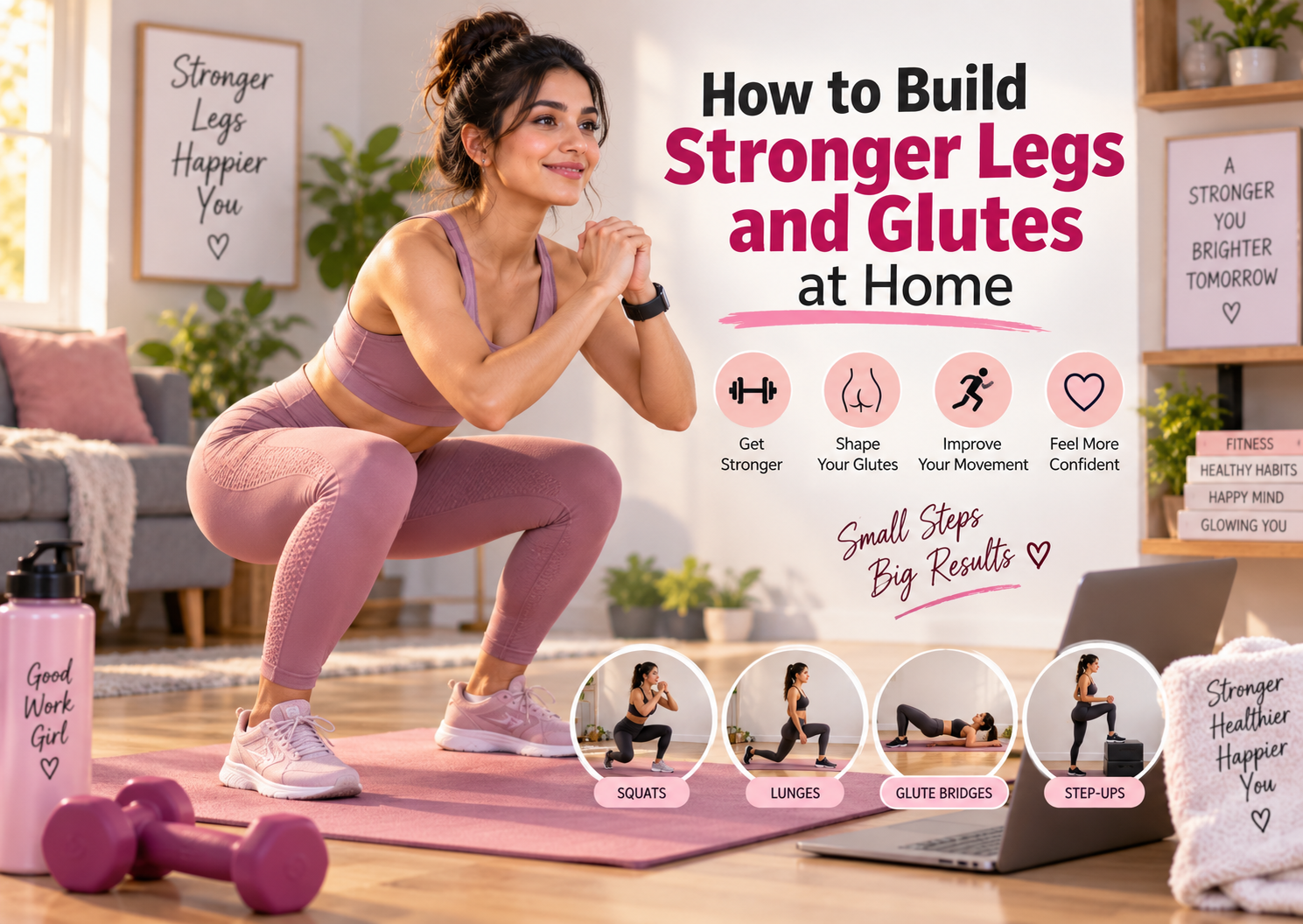
Build stronger legs and glutes at home with a simple routine that uses your body weight, household items, or a pair of resistance bands. You do not need an expensive gym membership to strengthen your lower body.
Your legs and glutes help you walk, climb stairs, maintain balance, and perform everyday movements. Regular strength training can also improve overall muscular fitness and physical function.
The CDC recommends that adults include muscle-strengthening activities at least two days a week.
The key is not doing hundreds of random exercises. It is choosing effective movements, using proper form, and gradually making your workouts more challenging.
Why Stronger Legs and Glutes Matter
Strong legs and glutes are about much more than appearance.
Your lower-body muscles support many everyday movements, including:
- Walking and running
- Climbing stairs
- Getting up from a chair
- Squatting and bending
- Carrying groceries
- Maintaining balance
- Supporting your hips and knees during movement
Strength training can also help you maintain muscle and physical function as you get older.
You can also combine your strength workouts with walking, cycling, dancing, or other aerobic activities to create a more balanced fitness routine.
Can You Build Stronger Legs and Glutes at Home?
Yes. You can make meaningful strength gains without a traditional gym.
Bodyweight exercises, resistance bands, dumbbells, and other home-based resistance methods can all be useful. The American College of Sports Medicine’s 2026 resistance-training guidance specifically notes that home-based training, bodyweight exercises, and elastic bands can be effective for improving strength and muscle development.
You can start with bodyweight exercises and add resistance later as your strength improves.
Best Exercises to Build Stronger Legs and Glutes at Home
1. Bodyweight Squats
Squats are one of the easiest exercises to add to a home lower-body workout.
They primarily work your thighs and glutes while also requiring your core to stabilize your body.
How to do them
- Stand with your feet around shoulder-width apart.
- Keep your chest lifted and your back comfortable.
- Bend your knees and push your hips backward.
- Lower yourself as far as feels comfortable while maintaining good form.
- Push through your feet to return to standing.
Start with 8 to 12 controlled repetitions.
2. Glute Bridges
Glute bridges are a simple way to focus on your glutes without needing equipment.
How to do them
- Lie on your back with your knees bent.
- Keep your feet flat on the floor.
- Place your arms beside your body.
- Tighten your glutes and lift your hips.
- Pause briefly at the top.
- Lower your hips slowly.
Avoid using momentum. Focus on controlled movement.
3. Reverse Lunges
Reverse lunges work your glutes and legs while also challenging your balance.
How to do them
- Stand tall with your feet comfortably apart.
- Step one foot backward.
- Lower your body while keeping control.
- Push through the front foot to return to the starting position.
- Repeat on the other side.
If regular lunges feel uncomfortable, reverse lunges can be a useful variation to try.
4. Step-Ups
If you have a stable, secure step or platform, step-ups can be a practical home exercise.
How to do them
- Place one foot securely on the platform.
- Push through that foot to step up.
- Bring the other foot up.
- Step down carefully.
- Alternate legs.
Do not use an unstable chair or surface. Safety should come before increasing the height.
5. Romanian Deadlifts
You can perform Romanian deadlifts with dumbbells, resistance bands, or another suitable form of resistance.
This movement focuses on the muscles along the back of your legs and your glutes.
How to do them
- Stand with your feet about hip-width apart.
- Hold your resistance close to your body.
- Keep your back in a comfortable neutral position.
- Push your hips backward while slightly bending your knees.
- Lower the resistance along your legs.
- Push your hips forward to return to standing.
The movement should come mainly from your hips rather than from rounding your back.
6. Glute Kickbacks
Glute kickbacks can be added to a beginner-friendly lower-body routine.
How to do them
- Start on your hands and knees.
- Keep your core gently engaged.
- Lift one leg backward and upward without twisting your hips.
- Lower it slowly.
- Repeat on the other side.
Keep the movement controlled instead of trying to lift your leg as high as possible.
7. Calf Raises
Strong lower legs are also important for a balanced leg workout.
How to do them
- Stand tall with your feet comfortably apart.
- Slowly raise your heels.
- Pause at the top.
- Lower your heels with control.
- Repeat.
You can hold onto a wall or sturdy surface if you need help with balance.
A Simple Home Leg and Glute Workout
If you are just starting, try this routine 2 to 3 times per week, allowing recovery between challenging lower-body sessions.
| Exercise | Repetitions |
|---|---|
| Squats | 8–12 |
| Glute bridges | 10–15 |
| Reverse lunges | 8–10 each leg |
| Step-ups | 8–10 each leg |
| Glute kickbacks | 10–15 each leg |
| Calf raises | 12–15 |
Start with 1 to 2 sets if you are a beginner. As the workout becomes easier, you can gradually increase the number of sets or add resistance.
The CDC notes that 8–12 repetitions can be an effective starting range for muscle-strengthening exercises, with additional sets providing more benefit for some people.
How to Make Your Home Workout More Effective
Doing the same easy workout forever will eventually stop challenging your muscles.
Instead, gradually increase the difficulty.
You can:
- Add resistance bands
- Use dumbbells
- Increase repetitions
- Add another set
- Choose a more challenging variation
- Slow down the lowering portion of an exercise
- Improve your range of motion when appropriate
- Reduce unnecessary rest gradually
This is known as progressive overload.
The important part is gradual progression rather than suddenly making your workout extremely difficult.
ACSM’s current guidance emphasizes that consistency and gradual progression matter more than complicated training techniques.
How Often Should You Train Your Legs and Glutes?
For general health, adults should perform muscle-strengthening activities at least two days per week.
You don’t necessarily need to train your legs every day.
A simple schedule could look like:
Monday
Legs and glutes
Tuesday
Walking or light activity
Wednesday
Rest or gentle movement
Thursday
Legs and glutes
Friday
Walking or another enjoyable activity
Saturday
Optional light lower-body workout
Sunday
Rest
Your ideal schedule depends on your fitness level, recovery, and overall activity.
Do You Need Weights to Build Your Glutes?
No.
Beginners can make progress with bodyweight exercises because the resistance may already be challenging enough.
However, as you become stronger, adding resistance can make exercises more demanding.
You could eventually use:
- Resistance bands
- Dumbbells
- Kettlebells
- An adjustable backpack with appropriate weight
- Other safe home resistance equipment
You do not need expensive equipment to create an effective home workout.
What to Eat for Stronger Muscles
Exercise is only one part of building strength.
Your body also needs enough energy and nutrients to support training and recovery.
Try to include a variety of:
- Eggs
- Dairy or fortified alternatives
- Beans and lentils
- Fish or lean meats if you eat them
- Tofu and soy foods
- Nuts and seeds
- Whole grains
- Fruits and vegetables
Rather than focusing on one “muscle-building food,” aim for a balanced eating pattern that provides enough protein and overall nutrition.
Common Mistakes to Avoid
Doing Too Many Exercises
More exercises do not automatically mean better results.
A few well-chosen movements performed consistently can be more useful than an extremely long workout.
Ignoring Your Form
Poor technique can make an exercise less effective and may increase injury risk.
Learn the movement first. Add repetitions or resistance later.
Training Every Day
Your muscles also need recovery.
Give your lower body time to recover between challenging strength sessions.
Expecting Results in a Few Days
Building strength takes time.
Instead of judging your progress only by how your body looks, notice improvements such as:
- More repetitions
- Better balance
- Improved control
- Heavier resistance
- Easier stair climbing
- Better exercise technique
Only Doing Glute Exercises
Your glutes are important, but your thighs, hamstrings, calves, hips, and core also contribute to lower-body strength.
A balanced routine is better than focusing on one muscle alone.
How Long Does It Take to See Results?
There is no exact timeline because progress depends on your starting fitness level, training routine, nutrition, recovery, genetics, and consistency.
You may notice improvements in exercise performance before you notice visible physical changes.
For example, you might eventually be able to perform more squats or lunges with better control.
Focus on getting stronger rather than chasing quick results.
Tips for Staying Consistent With Home Workouts
The best workout is one you can actually stick with.
Try these simple strategies:
- Choose a regular workout time.
- Keep your equipment somewhere easy to access.
- Start with short sessions.
- Track your repetitions.
- Increase difficulty gradually.
- Take rest days.
- Listen to your body.
- Choose exercises you enjoy.
- Avoid comparing your progress with fitness influencers online.
ACSM’s latest resistance-training guidance emphasizes that consistency is more important than making your routine unnecessarily complicated.
When to Take Extra Care
Exercise should be adjusted to your individual health and fitness level.
If you have an injury, chronic health condition, significant joint pain, or another medical concern, consider speaking with a healthcare professional before starting or significantly increasing your exercise routine. The CDC specifically recommends discussing appropriate activity with a healthcare professional for people with certain chronic conditions or disabilities.
Stop an exercise if you experience significant or unusual pain, dizziness, chest pain, or difficulty breathing.
Final Thoughts
Build stronger legs and glutes at home by keeping your routine simple and consistent. Squats, glute bridges, lunges, step-ups, deadlift variations, and kickbacks can give you a strong foundation without requiring a gym.
Start with manageable resistance, focus on good technique, and gradually make your workouts harder as you become stronger. You don’t need a perfect routine. You need one that you can follow consistently.
If you also want to improve your overall health, combine strength training with regular movement such as walking. Adults are generally advised to get at least 150 minutes of moderate aerobic activity each week along with muscle-strengthening activity on at least two days.
FAQs
Can I build stronger legs and glutes without going to the gym?
Yes. Bodyweight exercises, resistance bands, and home-based resistance training can all help improve strength.
How many times a week should I train my legs?
For general muscle strengthening, at least two days per week is a useful guideline for adults. You should also allow enough recovery between challenging workouts.
What is the best exercise for glutes at home?
There is no single best exercise for everyone. Glute bridges, squats, lunges, step-ups, and hip-hinge movements can all be useful parts of a balanced routine.
Can squats make your legs stronger?
Yes. Squats are a resistance exercise that can strengthen the muscles of the lower body when performed with appropriate technique and gradually increased difficulty.
Do I need weights for stronger legs?
No. Beginners can start with bodyweight exercises. As you become stronger, adding resistance can provide a greater challenge.
How long should a home leg workout be?
A workout does not need to be very long to be useful. A focused session of around 20–40 minutes can be enough for many beginners, depending on the exercises, sets, rest periods, and fitness level.